
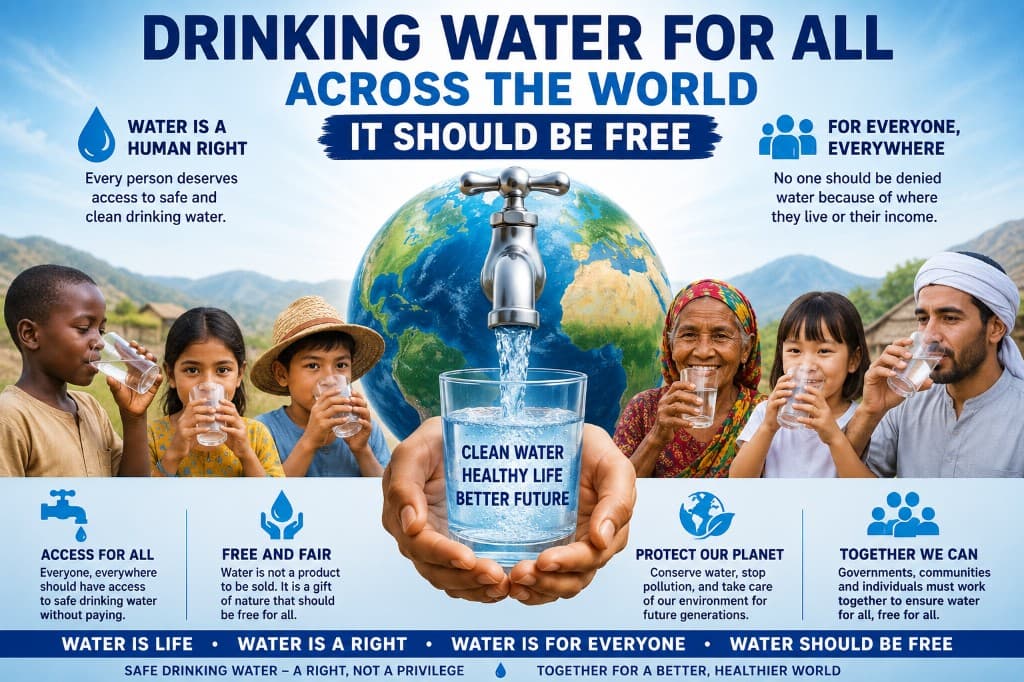
Drinking Water for All
8 June 2026 · La Fenêtre de Paris
Access to safe drinking water should be a universal right for every human being, regardless of nationality, income, religion, or social status. Clean water is essential for life, health, dignity, and development. Every person in the world should have access to sufficient and safe drinking water free of contamination and harmful pollution.
Millions of people around the world still suffer from water shortages, unsafe water sources, droughts, and poor sanitation. Many families, especially in developing countries, must travel long distances every day just to collect water that is often unsafe to drink. This situation contributes to disease, poverty, malnutrition, and the death of thousands of children every year.
Water should not be considered a luxury or a privilege reserved only for those who can afford it. Access to basic drinking water should be free and guaranteed for all people as part of fundamental human rights. Governments, international organizations, and communities must cooperate to invest in water infrastructure, purification systems, sanitation, and environmental protection.
Climate change, pollution, industrial waste, and global warming are placing increasing pressure on water resources worldwide. Protecting rivers, lakes, groundwater, and natural ecosystems is necessary to ensure clean water for present and future generations. Environmental actions such as reducing pollution, recycling waste, conserving water, planting trees, and using sustainable technologies can help preserve global water supplies.
Providing free and safe drinking water for everyone would improve public health, reduce inequality, support education and economic growth, and strengthen human dignity and social justice. Clean water is not a commercial product alone — it is a basic human necessity and a universal right that should be accessible to all people across the world.